All posts by Javier García Marín

JACS 2024

Alkanes C1–C6 C–H Bond Activation via a Barrierless Potential Energy Path: Trifluoromethyl Carbenes Enhance Primary C–H Bond Functionalization

Jonathan Martínez-Laguna, Julia Altarejos, M. Ángeles Fuentes, Giuseppe Sciortino, Feliu Maseras,* Javier Carreras,* Ana Caballero,* Pedro J. Pérez*

JACS 2024, ASAP
DOI: 10.1021/jacs.4c13065

In this mixed computational and experimental study, we report a catalytic system for alkane C1–C6 functionalization in which the responsible step for C–H bond activation shows no barrier in the potential energy path. DFT modeling of three silver-based catalysts and four diazo compounds led to the conclusion that the TpFAg═C(H)CF3 (TpF = fluorinated trispyrazolylborate ligand) carbene intermediates interact with methane without a barrier in the potential energy surface, a prediction validated by experimentation using N2═C(H)CF3 as the carbene source. The array of alkanes from propane to n-hexane led to the preferential functionalization of the primary sites with unprecedented values of selectivity for an acceptor diazo compound. The lack of those barriers implies that selectivity can no longer be controlled by differences in the energy barriers. Molecular dynamics calculations (with propane as the model alkane) are consistent with the preferential functionalization of the primary sites due to a higher concentration of such C–H bonds in the vicinity of the carbenic carbon atom.

Ilargi Goieaskoetxea

Ilargi Goieaskoetxea Arriaga

  • Project associate researcher Universidad de Alcalá (2024)
  • Master’s Degree in Synthetic and Industrial Chemistry, Universidad del Pais Vasco (UPV/EHU, 2023-2024)
  • TASSEP Exchange Program: 3-month stay at Université de Montréal (UdeM, 2022)
  • Graduated (Chemistry) at Universidad del Pais Vasco (UPV/EHU, 2019-2023)


XX Simposio de Jóvenes Investigadores Químicos de la RSEQ

XX Simposio de Jóvenes Investigadores Químicos de la RSEQ

Ciudad Real (Spain), 18 – 91 November

The Chemical Biology Group from the University of Alcalá was well represented in the Young Research Symposium of the Spanish Royal Society of Chemistry hold in the city of Ciudad Real.

– Flash + Poster:
· Modulating the pseudokinase integrin-linked kinase through new small molecules
Marta Durán, Mercedes Griera Merino, Ana María Carozo, Sergio de Frutos García, José Luis Aceña, Laura Calleros, Diego Rodríguez Puyol, Javier García-Marín

– Poster:
· 1,1-Diamine scaffold synthesis under visible light irradiation
Guillermo Morales-Ortega, Javier Carreras

– Poster:
· Acid-mediated synthesis of fluorescent functionalized polycycles via catiionic cyclization of o-acryloyl-o’alkynylbiaryls
Alex Hipólito-Barriuso, Patricia García-García, Manuel Á. Fernández-Rodgríguez

Adv. Synth. Cat. 2024

Combined Gold and Photoredox Catalysis: Synthesis of 3-Alkenyl-2H-Indazoles from 2-Alkynylazobenzenes

Clara Mañas, Estíbaliz Merino*

We disclose the intramolecular synthesis of 3-alkenyl-2<i>H</i>-indazoles from 2-alkynylazobenzenes promoted by a dual catalysis using AuCl3 and a ruthenium photocatalyst under irradiation with visible light. This reaction goes through a hydroamination of the alkynyl fragment. The yields are governed by the electronic factors. Control experiments and DFT calculations suggest that a radical and polar mechanisms are operating in parallel. This transformation goes through first formation and C-N bond and 1,2-hydride shift. Derivatization was also carried out to extend the versatility of this methodology.

Adv. Synth. Cat. 2024
DOI: 10.1002/adsc.202400990

J. Org. Chem. 2024

Copper-Catalyzed Hydroamination of 2-Alkynylazobenzenes: Synthesis of 3-Alkenyl-2H-Indazole

Clara Mañas, Juan Herrero-Bourdieu, Estíbaliz Merino*

A copper-catalyzed intramolecular synthesis of 3-alkenyl-2H-indazoles from 2-alkynylazobenzenes is described. The reaction proceeds in a single step via C–N bond formation and a subsequent 1,2-hydride shift, affording products in high yields. DFT calculations suggest the 1,2-hydride shift as the rate-determining step. Further derivatization enables functionalization of the 3-alkenyl-2H-indazoles.

J. Org. Chem. 2024.
DOI: 10.1021/acs.joc.4c02144

Org. Chem. Front 2024

Shaping cycles with light: a regiodivergent approach to tetracyclic aza-aromatic compounds

Clara Mañas, Ana Belén Ibarra, Estíbaliz Merino*

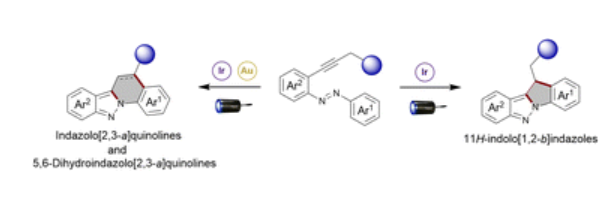
The development of regiodivergent methods that allow access to different structures from a single substrate through intramolecular processes is crucial for accelerating new molecule discovery, as well as making processes more sustainable and efficient in terms of waste production and economy. In this study, we report a novel regiodivergent cyclization procedure to access two distinct azapolyaromatic regioisomers from 2-alkynylazobenzenes. The key to achieving this regiodivergence lies in the presence or absence of a gold catalyst. The irradiation with visible light of 2-alkynylazobenzenes in the presence of a Ir photocatalyst affords 11H-indolo[1,2-b]indazoles, whereas under similar conditions with AuCl3, indazolo[2,3-a]quinolines are produced. Control experiments and DFT calculations suggest that both transformations operate through different reaction mechanisms: the formation of 11H-indolo[1,2-b]indazoles involves a radical mechanism, whereas the formation of indazolo[2,3-a]quinolines appears to proceed predominantly through a polar mechanism. This transformation enables the one-step conversion of simple 2-alkynylazobenzenes into diverse azapolyaromatic structures via an intramolecular visible light-promoted process, holding significant potential for new nitrogenated heterocycles.

Org. Chem. Front. 2024.
DOI: 10.1039/d4qo01606h